
The Blueberry War of 2025
You made it. This is the place.

Somewhere between tending blueberries and declaring war on a bird, I wrote a story. A true one. More or less. Of course, this wasn’t as much of a creative effort, as it was the historical documentation of actual events.
Feathers V. Foam: The Blueberry War of 2025 is what happens when a certified nursery professional, a robin with absolutely no respect for boundaries, and a backyard full of gnomes spend an entire summer sorting out who the garden actually belongs to. Nobody came out of it with their dignity fully intact. The water feature kept clugging through all of it.
You can read it below, or if you’d rather settle in and listen, hit play on the video and let me tell it to you the way it was meant to be told — with appropriate gravity and only a little shame (maybe a lot of shame…maybe).
Either way, you’re in the right place. Grab a coffee. You’re going to want one.
— Kevin
Feathers V. Foam
The Blueberry War of 2025
Told in Three Parts
Part One
A True Story — More or Less
By Kevin Mansoor
Chapter One: Eden
There is a particular kind of morning that belongs only to people who are up before the world has decided what kind of day it intends to be.
The sky is the color of a promise not yet kept. The dew is still on everything — on the hostas, on the lawn, on the rim of your coffee mug if you set it down for even a moment on the patio table. The air smells like earth and green things and the faint ghost of last night’s rain, even when it didn’t rain. It smells, in other words, like the beginning of something.
I am always up for these mornings. In the winter, at my keyboard, in the spring, in my sanctuary.
My neighbors, I suspect, are not. Their blinds are drawn. Their cars sit in their driveways like sleeping animals. The street is quiet in the particular way that streets are quiet when everyone with any sense is still horizontal.
I do not begrudge them this. In fact, I prefer it this way. I simply know something they do not.
The garden is different at this hour.
It belongs to you.
I take my coffee — black, with a dash of C8 oil, because I am a man who has made certain commitments to himself — and I push open the back door and step into what I can only describe as my actual life. Not the other life. Not the emails and the orders and the deadlines and the list of things that needed doing before the other things could get done. This life. The one with soil under the fingernails and a water feature that makes a sound like the world exhaling.
Clug. Clug. Clug.
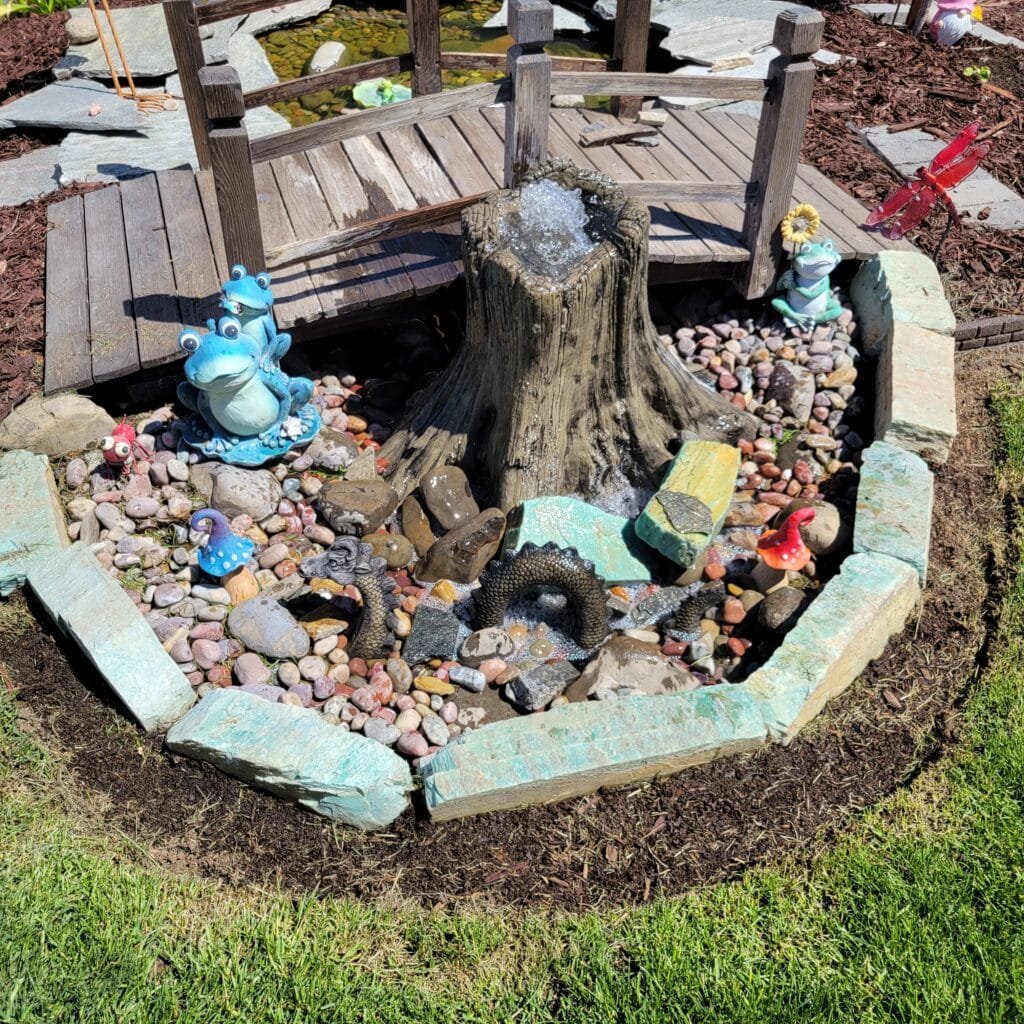
That sound. If I could bottle that sound and sell it, I would retire a wealthy man. It is the sound of the small pump in a concrete tree stump water feature — nothing elaborate, nothing from a magazine, just a stump and a pump and a little recirculating magic that had somehow become the heartbeat of the whole backyard. You stopped noticing it after a while, the way you stop noticing your own heartbeat. But if it ever went quiet, you notice that immediately. My heart did that once. . . I noticed.
The gnomes are already at their posts.
I should explain the gnomes.
Every garden has a personality, and every gardener, whether they admit it or not, participates in the construction of that personality. Mine has evolved, since we bought the new house with a mud patch in back two years before, into something that could best be described as whimsical with structural integrity. There are raised beds and precise pH testing, and a fertilization schedule loosely memorized in my head. There is a partially hidden gnome in the blueberry bushes who appears to be either sleeping or plotting. There is another in the strawberry patch whose expression, depending on the light and your mood, ranges from cheerful to vaguely threatening, like a smiling clown. His head is, in fact, a strawberry. There are more, maybe two dozen, all frozen in the daylight, waiting for the night to do their chores.
They have been arriving for years. Some were gifts. But, to be honest, mostly rescues from abusive stores that kept them in sterile environments without dirt and plants — devoid of life. I mean, I couldn’t just leave them there.
They kept watch. That was their job. They were, I believed, good at it. And if the task was too much for them, a dragon sits near the raised bed to help out.
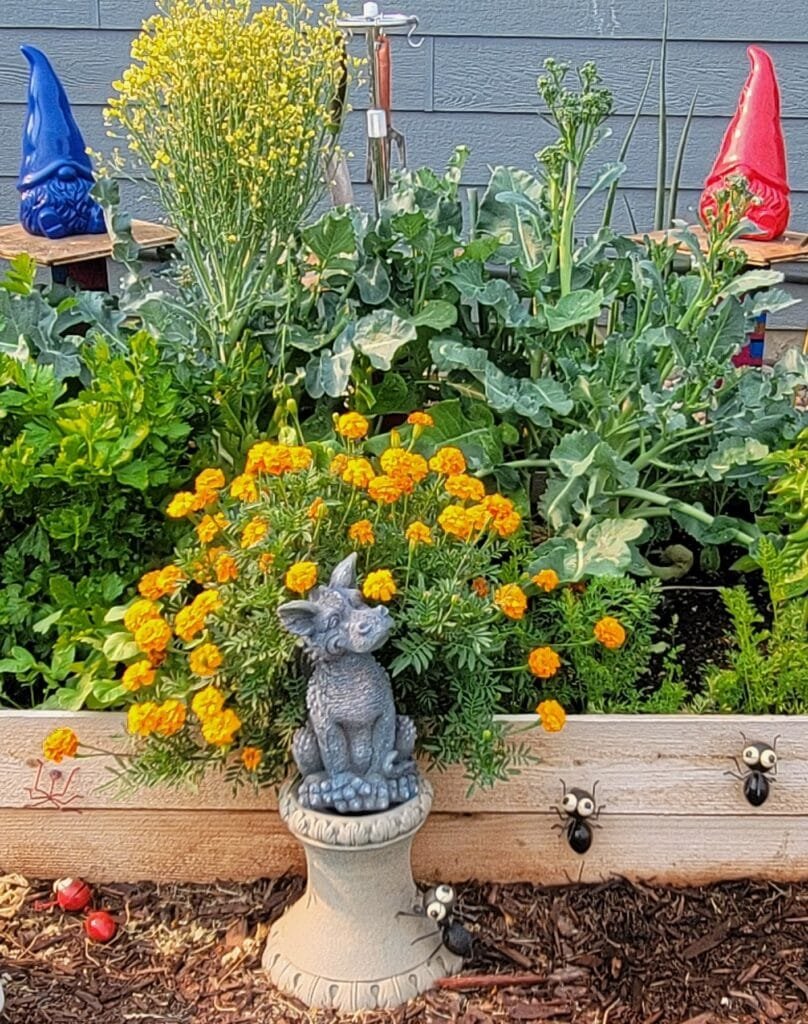
I move through the garden the way I always do in the early morning — slowly, with my life-giving coffee, making my rounds. This is not inefficiency. This is intelligence gathering. You cannot tend a garden you have not observed. You cannot observe a garden you are rushing through. The morning walk is the briefest and most important meeting of my day, and I am both the chairman and the only attendee. Well, except for the gnomes, but they are only allowed to observe, never speak up.
The blueberries first.
There are several bushes — Bluecrop, Patriot — arranged along the back fence in a configuration I had planned with some care. They are not yet producing. We are still in the long, patient season of tending without reward, of feeding and pruning and adjusting soil pH with the faith of a man who has done this before and knows that the berries are coming, they are always coming, you simply have to deserve them first.
I check the leaves. Check the new growth. Said a few words.
I know. I know it’s not time yet. You’re doing great. I see you.
I am aware of how this sounds. I stand by it entirely. I talk to my garden regularly. Just like I talk to my characters in my head when I write. Both are real in different ways. . . to me.
Then the strawberries.
The strawberry patch is my pride in a different way — less architectural, more sprawling, a winding irregular shape that follows its own logic along the side of the lawn. It is productive and chaotic and requires a certain tolerance for imperfection that has taken me some years to develop. Strawberries, I have learned, will not be managed. They will only be negotiated with. Ignore their runners, and well, grab the shovel.
I crouch down to check the progress of the earliest fruit.
That was when I saw it.
A strawberry. Sitting on the soil beside the patch. Not on the plant — beside it. Placed there, almost with a kind of casual deliberateness. Half eaten. The flesh exposed, bright red in the early light, the seeds still visible along the edge where something had bitten cleanly through.
I set my coffee down on the small bridge over the water feature. The same bridge my wife and I had gotten married on just a few years before.
Now that, said the part of my brain that had spent years in the nursery trade diagnosing exactly this kind of thing, is a clue.
I crouch lower. Examine the surrounding plants. Check for slug trails — none. Check the soil for more clues — none. Deer? No, not over our fence. Whatever did this was tidy. Whatever did this had, in fact, left the remainder behind like a calling card.
I stand up slowly and look around the garden.
I ask the strawberry gnome. After all, this was his domain. Nothing, perhaps a shoulder shrug.
The water feature clugs.
Something, I think, picking up my coffee, is getting into my strawberries.
I filed the information carefully in the part of my mind reserved for problems that were not yet emergencies, and went back inside to top off my coffee.
I am not alarmed.
I am a professional.
I have skills.
Score: Mystery Garden Invader: 1 Me: 0
The next morning was the same sky, the same dew, the same ritual. I pushed open the back door, coffee in hand, and stepped into the garden.
The gnomes were at their posts.
The water feature was clugging.
And there, in the strawberry patch, bold as original sin and twice as unrepentant, was a new face. Two black eyes staring at me. A robin.
Not a large bird. Not, objectively, a threatening bird. Burnt orange chest, dark back, bright eyes, the general bearing of a creature who has never once in its life considered the possibility that it might be unwelcome somewhere.
It had a strawberry in its beak.
My strawberry.
Our eyes met across the garden. Neither of us moved. The morning held its breath. The water feature clugged once, softly, and faded into the background as the spaghetti western music whistled in my head.
I looked at the robin.
The robin looked at me.
The strawberry, to its credit, said nothing.
And in that long, still, dew-soaked moment, something passed between us — some current of mutual recognition, some wordless agreement about what this was and what it was going to become.
I took a slow sip of my coffee.
The robin took a slow bite of my strawberry.
It was on.
Score: Robin: 2 Me: 0
Chapter Two: The Strawberry Campaign
I am a professional.
I have certificates. I have years. I have a fertilization schedule that lives, mostly, in my head, which is where the best fertilization schedules live because writing them down implies a rigidity that gardens simply will not tolerate. I have diagnosed root rot, treated iron deficiency, and once talked a dying Japanese Maple back from the absolute brink through a combination of soil amendment and what I can only describe as emotional support.
I know what I am doing out here.
Which is why, standing in my garden a few days after the Great Strawberry Incident of 2025, I approach the problem the way any reasonable, credentialed, experienced nursery professional would approach it.
I cover the patch with frost cloth.
Done. Problem solved for under $20. Good morning.
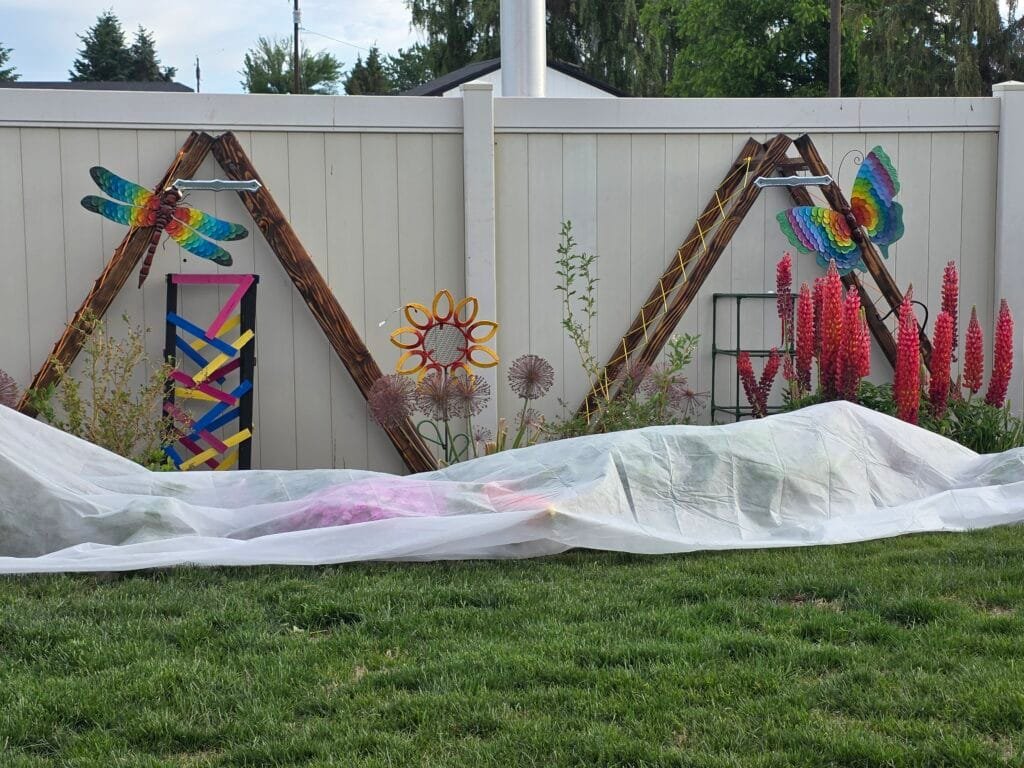
I am aware, says the part of my brain that will not stop editorializing, that this is the gardening equivalent of putting a sign on your sandwich in the office refrigerator. But the other part of my brain — the professional part, the certified part — tells that part to be quiet. The frost cloth is a physical barrier. The frost cloth is a proven deterrent. The frost cloth is the solution.
The robin, it turns out, has his own opinions about the frost cloth.
Not about the cloth itself. The cloth is, by any reasonable assessment, adequate coverage for approximately ninety-two percent of the strawberry patch. I have tucked the edges. I have weighted the corners with smooth river stones I selected specifically for this purpose because if you are going to defend your strawberries you may as well do it with some aesthetic consideration.
But the strawberry patch, as I have mentioned, is an irregular shape. Winding. Organic. Following its own logic along the side of the lawn in the way that strawberries do when you have given them a few seasons to express themselves and have not been aggressive enough with the runners. Which I have not. Which I stand by.
And at the far end of that winding irregular shape, where the cloth does not quite reach because geometry is undefeated, there is a strawberry.
One strawberry.
The strawberry, apparently, because that is where he is.
I am watching from the kitchen window with my second coffee, and I want to be clear that I am not hiding. I am simply observing from an interior vantage point that happens to require me to stand very still and slightly to the left of the window. Definitely not hiding.
He finds the edge in approximately four seconds. I have been adjusting that cloth for twenty minutes.
Four seconds.
He tips his head to one side in a way that I am choosing to interpret as accidental but which I am privately certain is theatrical. Then he disappears under the edge and emerges with a strawberry and I press my forehead gently against the window glass and breathe.
Fine.
I go outside and adjust the cloth.
Score: Robin: 3 Me: 0
This is how the next two weeks go.
I adjust. He finds the edge. I adjust again. He finds the new edge. I add a stone. He goes around the stone. I add another stone. He goes around that one too. I run out of aesthetically appropriate stones and start using a brick I find near the shed, which ruins the whole visual and frankly offends me on a personal level, and he goes around the brick.
Score: Robin: 15+ Me: 0
What I do not expect, and what I am not prepared for, is what happens next.
The strawberries end.
Not because of him — mostly not because of him — but because the season turns the way seasons do, indifferent to the dramas being enacted beneath them. The strawberries are done. The patch goes quiet. I remove the frost cloth and the river stones and the brick that has been bothering me for two weeks and I fold everything up and put it away and I think: that’s over.
And then I look up.
He is on the fence.
Just sitting there. Watching me fold the frost cloth with what I can only describe as professional interest.
What follows is a period I will refer to in my personal historical record as The Interlude.
The blueberries are turning, slowly, from green to the pale blush that precedes the deep blue that precedes the moment I have been tending toward since March. We are not there yet. We are weeks away. The bushes are full and promising and I check them every morning on my rounds with my coffee, touching the clusters gently, doing the math.
He watches.
He is also doing the math.
He is in the garden every day now. Not always at the strawberry patch or blueberry bushes. Sometimes at the water feature, which he has apparently decided is his personal spa. Sometimes on the fence, in his spot, which has become his spot in the way that certain chairs in certain houses become certain people’s chairs, and everyone just accepts it.
Sometimes in the blueberry bushes. Sometimes talking to them.
I know. I know it’s not time yet. You’re doing great. I see you.
Did he just quote me?
He’s not eating. Just… visiting. Perching on a branch and tipping his head and looking at the clusters with an expression I recognize because I wear it myself every morning.
Not yet, that expression says. But soon.
I stand at the kitchen window with my coffee.
He sits in my blueberry bush.
We are, I realize with a feeling I cannot quite name, on the same schedule.
The morning I walk out and find him actually in the bush, actually among the berries, my blood pressure does a thing that my doctor has asked me, on multiple occasions and with increasing specificity, not to let it do.
He looks at me from inside the bush.
The berries are not quite ready. Still a touch too light. Another few days, maybe a week.
He knows this too. He is not eating. He is auditing.
He hops to a slightly higher branch, tilts his head, and looks at the cluster nearest to him with the focused attention of a man reviewing a spreadsheet he has already memorized.
Then he looks at me.
I see you, that look says. I see all of this. I have plans.
I pick up my coffee.
Walk back to the patio, shaking my head.
Oh no, I think, with the quiet dread of a general who has just understood the battlefield for the first time.
No no no.
The blueberry campaign is coming.
And I am not ready.
Score: Robin: 15+ Me: 0 Blood Pressure: Rising
Chapter Three: Escalating Force
I am not a man who gives up easily.
The blueberries are dark. Not all of them. Some of them. I give them the tickle test. Nothing falls. But enough of them are dark that the morning audit has shifted from soon to days, and the particular anticipation that lives in a gardener’s chest in that final stretch before harvest is humming at a frequency I feel in my back teeth.
He feels it too.
Phase One begins the way all reasonable military operations begin — with lumber.
I construct individual frames around each blueberry bush. Wood, netting, the whole architecture of a man who has thought this through and is confident in the solution. It takes most of a Saturday morning. I measure. I cut. I staple. I step back and look at what I have built and feel the specific satisfaction of a problem that has been solved by a person with a plan.
By Sunday morning he is inside the cage.
I have built him a dining room.
I dismantle the cages on a Tuesday with the quiet dignity of a man who is absolutely not defeated and is simply choosing a different strategy.
Score: Robin: 24 Me: 0 Lumber: Wasted
Phase Two arrives in a small cardboard box from the internet.
Net bags. Individual mesh bags sized to slip over each bush. They work. I want to sit with that for a moment because it does not happen often in this story.
They work.
He lands on the fence the next morning and finds every bush wrapped. He hops from branch to branch with increasing irritation, pecking at the mesh, finding no purchase, finding no entry. I watch from the patio with my coffee and feel something I have almost forgotten.
Victory.
Score: Robin: 24 Me: 1 Dignity: Partially Restored
Except.
The bags are dense. Good dense, protective dense, but dense enough that on overcast days the berries are not getting their full sun. And berries that do not get their full sun do not reach their full sweetness. And berries that do not reach their full sweetness are berries that have been protected but not fully realized and that is not acceptable to me on a philosophical level.
So on sunny mornings I remove the bags.
He is in the bush before I am back through the patio door.
How.
Score: Robin: 31 Me: 1 Weather: Complicit
It is during one of these sunny morning incursions that the Nerf guns enter the story.
The guns were purchased for my granddaughter and me. That is the truth and I stand behind it fully. What happened next was simply a matter of resource allocation in a time of need.
There are two of them. One lives on the patio table. One lives next to the raised bed. Both are loaded.
My wife did not ask about the guns.
I have not explained the guns.
Some marriages are maintained through strategic silence.
The thing about Nerf guns and robins is this: the guns do not hurt him. I am trying to communicate a boundary through the universal language of mild inconvenience, and it works, mostly, in the sense that when I fire he leaves the bush and retreats to the fence and gives me a window of thirty to forty-five seconds before he comes back.
Thirty. Seven. Seconds.
He has a move. He comes in fast and low when I am not watching and he grabs a berry and he goes to the fence. He sits on the fence post. He eats the berry. On the fence. Slowly. Looking directly at me the entire time.
He is taunting me.
Then one afternoon he does it and I fire and he does not fly off.
He shifts his weight slightly on the post.
That is all.
He shifts his weight and continues eating.
I fire again.
He blinks.
I lower the gun.
He finishes the berry.
Then — I know how this sounds, I know exactly how this sounds, but I saw what I saw — he ruffles his feathers once, slowly, and he shifts his weight, lifts the foot closest to me, extends one talon slightly forward, and holds it there for just a moment.
The middle talon.
He gives me the middle talon and then looks away like I am no longer worth his attention.

I spend thirty minutes picking up nearly one hundred nerf bullets. Truth be known, a year later and I still find them.
Score: Robin: A lot. Me: 1. My Pride: Composting in a Raised Bed.
Chapter Four: The Dark Night of the Soul
There is a moment in every conflict when the noise stops.
I am on the patio.
He is on the fence.
Neither of us is doing anything in particular.
I make my list.
One Saturday morning building cages that a bird defeated before Sunday breakfast. An unknown but significant quantity of river stones now permanently reassigned from aesthetic duty to strategic duty. One brick that still offends me every time I look at it. Approximately thirty minutes of my life on my hands and knees in the garden picking up nearly one hundred foam darts.
The accumulated dignity of a certified nursery professional who has been outwitted, consistently and completely, by an animal with a brain the size of a walnut.
I pause on that last one.
A walnut.
I hold my coffee mug with both hands and consider what it means that the walnut has been winning.
He shifts his weight on the fence post and looks at the blueberry bushes with the calm assessment of a property manager reviewing an investment that is performing exactly as expected.
I follow his gaze to the bushes.
And here is the thing that hits me, sitting on that patio, that I was not expecting to get hit with —
They’re doing great.
The bushes. They are full and dark and heavy with the kind of berry that you only get when you have been paying attention all season.
And so did he, in his way.
Not the caring I did. But the mornings he sat in the branches and checked the clusters. The way he waited, with the same patience I had, for the color to shift from green to blush to deep perfect blue.
He was invested.
He chose this garden. Not the garden next door. Not the park two blocks away. Not anywhere else.
This garden. With its uneven ground and its gnomes and its dragon and its concrete stump water feature that sounds like the world exhaling.
Why?
I think about what I said to myself the first morning I stood in this garden and understood what it was becoming.
It belongs to you.
And I think about a robin, arriving in a new garden in the early spring, finding a water feature and shelter and food and the particular quality of stillness that only exists in a garden that someone loves. Finding, in other words, a sanctuary.
The same thing I found.
I have been thinking of this as an invasion.
But here is the question I have been avoiding —
Who was here first?
Not me. Not in any way that matters to a robin. I arrived two years ago with my raised bed plans and my pH meter and my gnomes rescued from abusive stores. I planted things and called it mine.
He arrived in the spring and found food and water and safety and called it his.
We are both right.
He didn’t invade my sanctuary, I think, with the slow arrival of an understanding that has been working its way toward me all summer.
He found his own.
There is a kind of peace that lives on the other side of a reckoning.
I look at him properly for the first time — not as a target, not as an adversary. Just as a bird. A small, burnt-orange-chested, bright-eyed bird who picked my garden out of every available garden and decided this was the one worth coming back to.
Every day.
All summer.
Even when I was shooting at him.
The thought arrives with a comedy I was not expecting and I laugh out loud, alone on my patio.
I look at him.
He looks at the blueberry bushes.
We sit together in the garden that belongs to both of us, in the morning that belongs to both of us, and somewhere in that quiet, without ceremony or announcement, something shifts.
Not surrender. Not defeat. Something more like recognition.
Hello, I think, in the direction of the fence.
He ruffles his feathers once. Settles.
The water feature clugs.
Hello, the garden says back.
Score: The Garden: Everything. Us: Finally Even.
Chapter Five: The Armistice
There is a protocol to ending a war.
I have been thinking about the branches.
Specifically, three branches on the big Bluecrop in the corner. Full clusters. Dark, perfect, heavy with the particular weight of a berry that has arrived exactly where it was always going.
What if I just didn’t.
What if I just didn’t bag those three branches.
I am choosing peace.
I do it on a Tuesday morning.
No ceremony. No announcement. I come out with my coffee in the early light and I do my rounds. And then I walk past the three branches on the Bluecrop in the corner and I do not touch the bags.
Because there are no bags on those branches.
Because I did not put bags on those branches.
Intentionally.
I set my coffee down on the bridge and stand there for a moment looking at those three uncovered clusters and I feel something I was not entirely prepared to feel which is a very specific and quiet kind of relief.
Like putting down something heavy that you have been carrying so long you stopped noticing the weight.
I pick my coffee back up.
Turn around.
He is on the fence.
We look at each other across the garden in the early morning light.
I raise my coffee mug.
Not high. Not theatrical. Just a small lift. An acknowledgment. One gardener to another.
He tips his head.
Terms accepted, that tip says.
I take a sip of my coffee.
He flies to the Bluecrop in the corner.
I watch him work those three branches with a professionalism that I have no choice but to respect. He is not frantic about it. He is not greedy. He moves through the clusters with the same methodical attention I bring to my own harvest.
He knows what is ready.
Of course he does.
I harvest the netted clusters while he harvests his. We work the bush together in the early morning, the two of us, in a silence that is not uncomfortable for the first time all summer.
My bowl fills.
His branches empty.
We finish at approximately the same time.
I eat three berries standing right there at the bush, which is my tradition and my right, and they are extraordinary. Dark and sweet and warm from the morning sun and tasting exactly like the thing you waited for when you deserved it.
I wonder if his taste the same.
I decide they probably do.
The rest of the summer settles into something I would not have predicted in May.
Not friendship. I want to be precise about that. We are not friends. But something.
He is in the garden every day, which has not changed. But the quality of his presence is different now, or perhaps the quality of my attention to his presence is different, which may be the same thing.
I stop tracking the scorecard.
It is a sanctuary.
It belongs to both of us.
The gnomes knew this the whole time, I think. Even the smirking one. Especially the smirking one.
Autumn comes the way it always does in Yakima — not gradually but decisively, like a door closing on a room you loved.
The robin is less present now. His visits are shorter, less purposeful.
One morning in late September I come out with my coffee and he is on the fence in his spot and we do our thing — the mutual acknowledgment, the shared silence — and then he is gone.
Not dramatically. Not with ceremony. He just isn’t there the next morning.
The garden goes on without him the way gardens go on without things. The gnomes keep their posts. The dragon watches the raised bed. The water feature clugs into the cooling air.
I find a foam dart near the strawberry patch in October, half buried in the mulch, and I pick it up and look at it for a long moment before putting it in my pocket.
Evidence, I think. Of something.
And then it is spring again.
I am crouching at the strawberry patch, checking the earliest crowns, when I feel it.
That specific, particular quality of being watched.
I look up slowly.
He is on the fence. In his spot.
Same unbothered posture. Same bright eyes with the general bearing of a creature who has never once considered the possibility of being unwelcome somewhere.
We look at each other across the garden in the early morning light.
You’re back, I think.
He tips his head.
Obviously, that tip says.
I look at the strawberry patch. Look at the fence. Look at him.
I stand up slowly, coffee in hand, and go back inside and I come back out and put the Nerf gun on the patio table.
Just in case.
Then I go back inside and I come back out again with a second mug and I set it on the bridge next to mine, filled with water, pointed at the fence, which is insane and I know it is insane and I do it anyway because this is my garden and I am allowed to be insane in it if I want to.
The water feature clugs.
The gnomes are at their posts.
The dragon keeps watch.
He is on the fence.
I am on the patio.
Here we go, I think, with something that is not quite a smile and not quite a sigh and is mostly just the feeling of a summer arriving with its shape already in it, already full of something, already a story before it has even begun.
Here we go.
Epilogue: The Record
The conflict herein described was real. The garden is real. The gnomes are real, all two dozen of them, and they have opinions about everything that happened and have chosen, wisely, to keep those opinions to themselves.
The robin is real. He returned this spring. He was on the fence in late February in what has been a very early spring here in Yakima in 2026. He was in his spot, with the posture of a creature who has never doubted his welcome anywhere.
The scorecard on the fence post is real. I have not counted the notches. I do not intend to.
Three branches on the big Bluecrop in the corner will remain unnetted. This is not weakness or defeat. This is diplomacy.
And the middle talon. . .
The Nerf gun is on the patio table. Loaded. It will stay there.
Some wars don’t end. They just find their terms.
The water feature clugs.
Court adjourned.
There’s a Part Two. He insisted. The Corrected Record — by the Bird.
Just open the door to continue.
Know someone who’d love this? There’s a way to send it — properly — coming soon.